Our History
Two decades of resident-led work in North Port St. Joe
Our Story
A legacy of grassroots organizing and neighborhood revitalization
North Port St. Joe CDC grew from resident determination to address affordable housing, economic opportunity, environmental justice, and social equity in Gulf County. Today it is a recognized force, with real estate assets, program delivery capacity, and experienced board leadership guiding its next chapter.
- Year founded
- 2005As the Gulf County CDC
- Bridgeport homes
- 31Co-created in North Port St. Joe
- Major grants
- $1,324,000EPA, Jessie Ball duPont, and RWJF
- Community properties
- 3Held for housing and mixed-use plans
Briefing
The Full Story on One Page
Est. 2005 · Housing Roots
Gulf County CDC builds a foundation in housing
The organization began as the Gulf County CDC, formed by residents determined to address affordable housing, economic opportunity, and equity in Gulf County.
- 1938–1999 — The paper mill years. The St. Joe Paper Company mill opens in 1938 beside North Port St. Joe, a community settled in the late 1800s and early 1900s. When the mill closes in 1999 it leaves behind contaminated land, sinking homes, and a neighborhood in decline.
- 2005 — Gulf County CDC is established. Phase 1 of the organization begins with a focus on homeownership and housing preservation.
- SHIP housing programs. The CDC manages State Housing Initiatives Partnership (SHIP) programming to help families buy and keep their homes.
- 2006 — Bridgeport Development. The CDC co-creates the 31-unit Bridgeport Development, affordable housing established with the St. Joe Company in North Port St. Joe.
- Homeownership Center and Housing Coalition. The CDC establishes the Gulf County Homeownership Center and the Gulf County Housing Coalition.
- 2009 — The first North Port St. Joe Master Plan. After the neighborhood joins the Port St. Joe Redevelopment Expansion Area in 2006, residents help create the 2009 North Port St. Joe Master Plan, which calls for preserving the Washington High School building. The recession stalls the plan within months.
Est. 2016 · Resident-Led Planning
The Project Area Coalition and the 2016 Master Plan
As the Project Area Coalition (PAC), residents took the lead on policy planning, environmental justice advocacy, and neighborhood stabilization.
- 2016 — The PAC era begins. In February 2016, North Port St. Joe residents and property owners form the Project Area Coalition to revisit the neighborhood's 2009 plan, this time with the goal of carrying it out.
- 2016 — Three workshops and a new plan. With support from the Jessie Ball duPont Fund and the Port St. Joe Redevelopment Agency, the PAC holds community workshops in July, August, and October, each drawing 30 to 60 people. In December it publishes "Redeveloping North Port St. Joe," an illustrated update of the 2009 plan that makes revitalizing the Washington High School campus, including reuse of the gym, a top priority.
2018–2021 · Crisis Response
Hurricane Michael and COVID-19
When disaster struck, the CDC served as trusted local infrastructure, among the first to help the community after Hurricane Michael and again through the pandemic.
- 2018 — Hurricane Michael recovery. Post-hurricane essentials, roof-repair support, and recovery navigation. FEMA and the EDA praised the 2016 Master Plan as crucial to redevelopment.
- 2019 — First Health Impact Assessment. The Florida Department of Health in Gulf County carries out a health project focused solely on North Port St. Joe.
- 2020 — COVID-19 response. On the eve of the pandemic, the CDC begins delivering food and cleaning products to 90 seniors and disabled residents, alongside benefits navigation and trusted public health communication.
- 2021 — The Farmacy on Avenue A. Jessie Ball duPont Fund grants expand the CDC's food delivery and open the Farmacy, a fresh produce store on Avenue A, funded with $48,000.
- 2021 — Second Health Impact Assessment. Completed with the University of West Florida and the University of South Florida.
2018–Today · Building Capacity
From Pioneer Bay CDC to North Port St. Joe CDC
The organization deepened its institutional capacity, aligned community priorities with CRA investment, and brought major federal and foundation funding home.
- 2018 — Pioneer Bay CDC and CRA alignment. With support from the Project Area Coalition, the organization launches as Pioneer Bay CDC, aligning community priorities with Community Redevelopment Agency investment and redevelopment strategy.
- 2022 — Three EPA grants, a regional first. North Port St. Joe becomes the only community to receive all three EPA grants: $200,000 to tackle unsafe housing conditions (late 2021), $199,790 for Brownfields job training (early 2022), and about $500,000 for environmental site assessments and cleanup plans. EPA Region 4 presents the awards in May 2022.
- 2023 — Stopping an LNG terminal at the old mill site. Residents learn in 2022 of a proposed liquefied natural gas export terminal at the former paper mill. A January 2023 community meeting draws 150 Black and white residents, and the PAC and Pioneer Bay CDC file a brief backing Public Citizen's challenge to federal regulators' decision not to review the plant. The developer cancels the project in July 2023.
- 2023 — EcoWorkforce graduates its first class. The EPA-funded EcoWorkforce Training Program celebrates its first graduating class. The free 6-week program, now in its 3rd cohort, prepares residents for higher-wage environmental jobs with OSHA, GIS, and site assessment credentials.
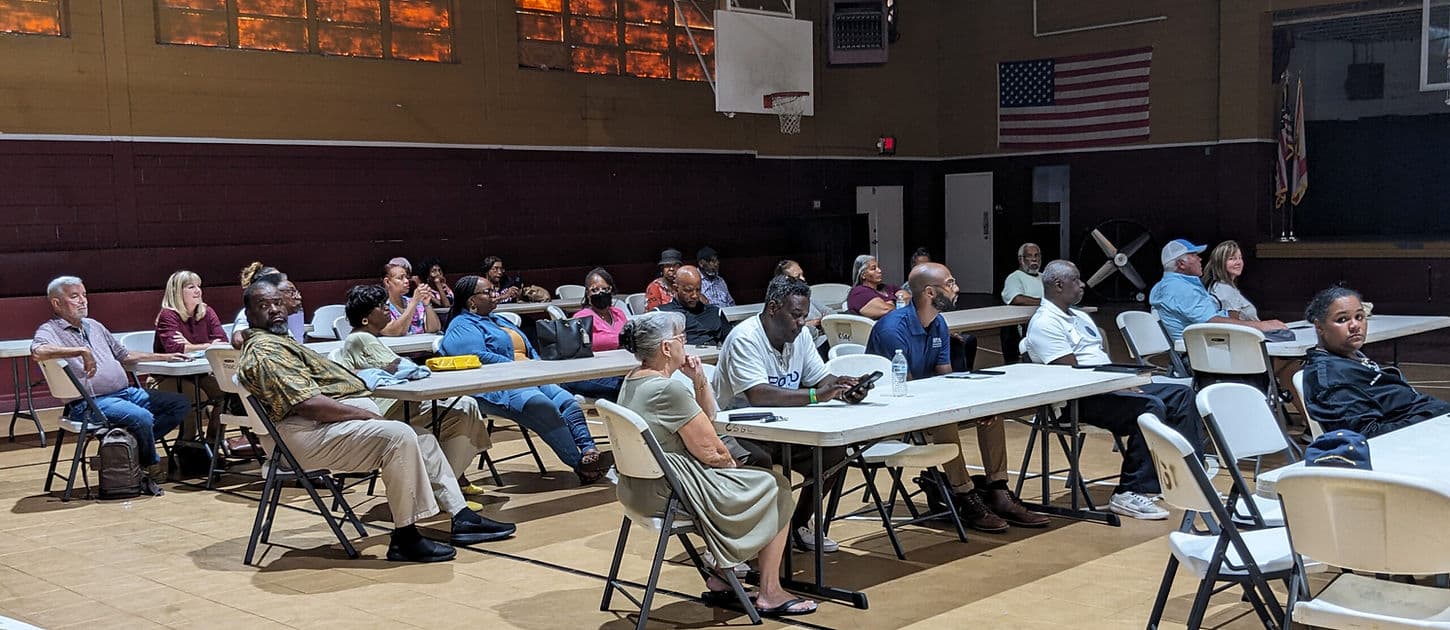
- 2023 — A vision for the Washington High gym. In October, more than 30 residents gather at the George Washington High School gym as Professor Cleary Larkin of the University of Florida's Historic Preservation Program and architect Carter Quina present renovation plans, including retractable seating, an upgraded kitchen, meeting rooms, and a possible disaster shelter. The CDC also applies to list the gym on the National Register of Historic Places.
- 2024 — A new name and a full-time CEO. In November 2024, Pioneer Bay CDC becomes North Port St. Joe CDC and names J. Richard Benderson its first full-time chief executive officer.
- 2026 — Changing Currents report. A Robert Wood Johnson Foundation research team publishes health equity scenarios for North Port St. Joe in 2050.
Next 2–3 Years · The Next Chapter
Properties, governance, and strategic growth
With three community properties and an experienced board, the CDC is positioned to move from planning to building, and residents can help write what comes next.
- Develop three community properties. Advance affordable housing and mixed-use plans on the CDC's three properties.
- Strengthen governance. Build board leadership systems, and integrate and mentor new board members.
- Expand engagement. Grow community visibility, with board members serving as accountable ambassadors.
Support and Partnerships
Who Made It Possible
Funders and partners who have invested in North Port St. Joe's resident-led vision.
Grants and funding highlights
- U.S. Environmental Protection Agency$899,000
- Jessie Ball duPont Fund$300,000
- Robert Wood Johnson Foundation$125,000
- Florida Department of Economic Opportunity (now FloridaCommerce)State support
Collaborative partners
- University of West Florida
- University of South Florida
- Florida A&M University
- UF-FIPR
- ReGenesis Institute
- EPA Region 4
- Northwest Florida Water Management District
- Florida Brownfields Association
Help Write the Next Chapter
Your support helps turn three community properties, a resident-led Master Plan, and two decades of advocacy into lasting change.